August 11, 2026 • Margot Ellery • 9 min reading time • Prices verified June 13, 2026
Cruz V3 vs. Vista V3: Which UPPAbaby Chassis Is Worth the $100 Difference
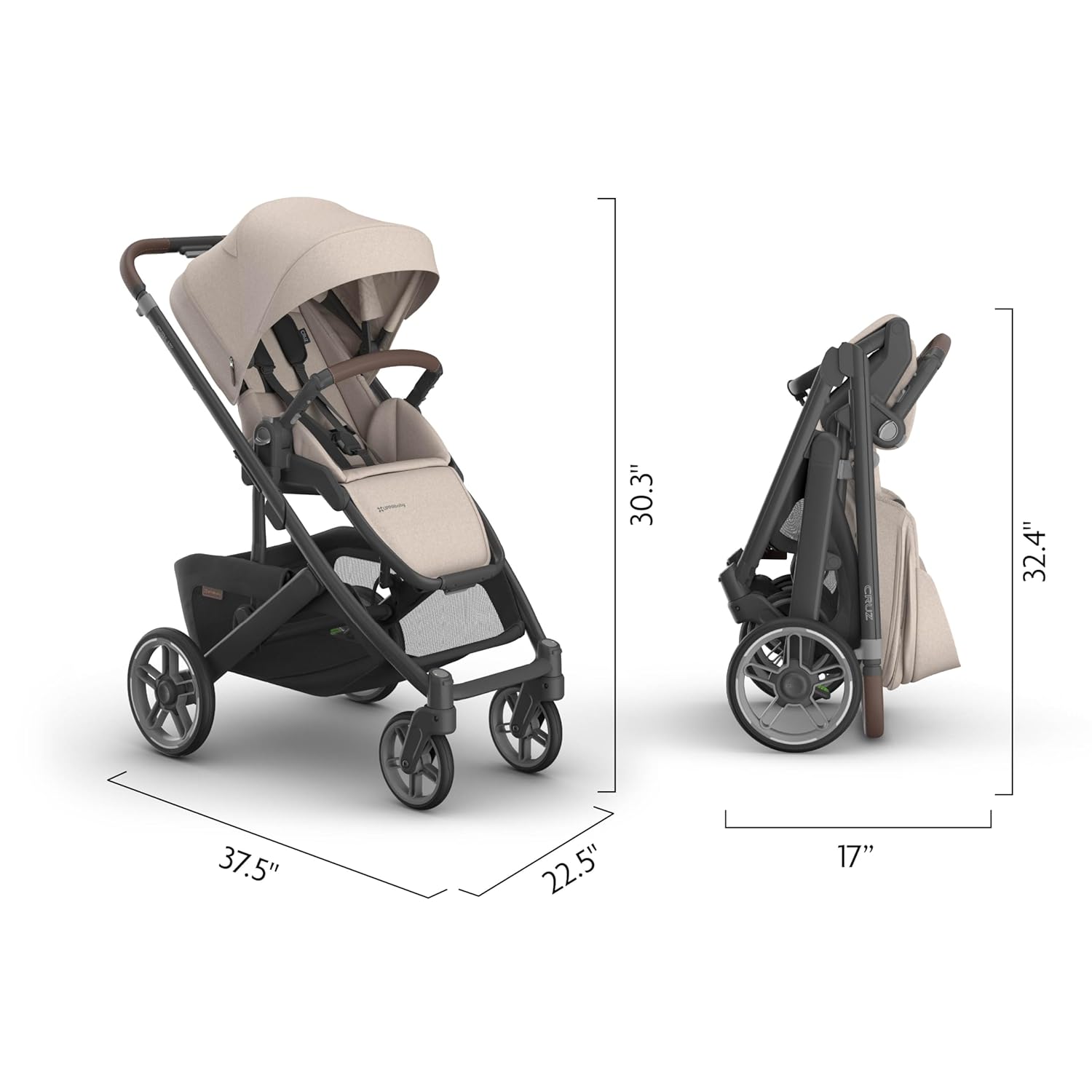
If you’re new to stroller research, here’s the quick orientation: UPPAbaby is an American brand known for building strollers that feel genuinely well-made, hold their resale value unusually well, and come with an ecosystem of compatible accessories — car-seat adapters, bassinets, rain covers — that work together without a lot of fuss. The Cruz V3 and Vista V3 are their two mid-to-upper-range single strollers. Think of them as the compact sedan vs. the full-size SUV in the same model family. Both run on the same brand DNA. Both fold in one motion, accept a bassinet for newborns, and work with UPPAbaby’s MESA car seat (an infant-safe carrier that clicks directly into the stroller frame) without an adapter. The price gap, as of May 2026, is roughly $100: Cruz V3 at approximately $700, Vista V3 at approximately $800. This article explains exactly what that $100 buys, when it matters, and when it genuinely doesn’t.
If you’ve already done a lap around the UPPAbaby lineup, you know the real question isn’t specs — it’s decision frame. You’re not here for a feature list. You’re trying to figure out whether your specific life — your city block, your sibling plan, your trunk — justifies stepping up. Let’s work through it.
The Honest One-Minute Spec Comparison
Before the nuance, the numbers. Published specs as of V3 launch:
| Feature | Cruz V3 | Vista V3 |
|---|---|---|
| MSRP (2026) | ~$700 | ~$800 |
| Weight | ~26 lbs | ~27.5 lbs |
| Folded dimensions (approx.) | 28” L × 22” W × 19” H | 35” L × 24” W × 17” H |
| Max child weight | 50 lbs | 50 lbs |
| Converts to double | No | Yes (with RumbleSeat) |
| Bassinet included | No (sold separately) | Yes |
| UPF canopy rating | UPF 50+ | UPF 50+ |
A few things jump out immediately. The weight difference is marginal — about 1.5 lbs. The canopy protection is identical. The child weight limit is the same. The fold is different in character: the Cruz V3 folds smaller in two dimensions (footprint and height) but longer front-to-back, which matters depending on whether you’re fitting it in a trunk or storing it in a hallway closet. And then there’s the headline difference: only the Vista V3 can grow into a double stroller.
Where the Cruz V3 Wins
The urban fold advantage
The Cruz V3’s folded profile fits more easily into smaller car trunks and compact SUV cargo areas — the kind of real-world detail that sounds minor until you’re wrestling a stroller into a parking garage twice a day. BabyGearLab’s long-term UPPAbaby stroller review series has identified the Cruz’s folded footprint as a recurring practical advantage for city-based families relative to the Vista’s wider collapsed stance. Published dimensions put the Vista V3’s folded length at approximately 35 inches — long enough that it won’t lie flat in several common compact-SUV trunks without repositioning, and wide enough to conflict with narrow entryway storage. If your stroller needs to live in a coat closet, this matters more than most reviews acknowledge.
UPPAbaby
$49.99
In stock on Amazon
Check price on AmazonStair-carrying and everyday lift
1.5 lbs sounds like nothing. Across three flights of brownstone stairs or a daily subway commute, owners consistently report it adds up fast. The Cruz V3 is the chassis you want if stair-carrying is a regular part of your routine. BabyGearLab’s UPPAbaby stroller testing notes weight-in-use as a meaningful differentiator for urban families in walkup buildings, where lift frequency amplifies small weight differences over the course of a week.
UPPAbaby
$49.99
In stock on Amazon
Check price on AmazonThe one-child cost-of-ownership story
If you know you’re stopping at one child, the Cruz V3’s inability to convert to a double isn’t a bug — it’s simply irrelevant. You’re paying $100 less for a chassis that covers all the same functional ground for a single child: same MESA car seat compatibility, same UPF 50+ canopy, same smooth-rolling wheel system. Cruz V2 units in good condition have been reported by secondhand stroller market observers through early 2026 as typically moving at 55–65% of original MSRP, creating a competitive total cost-of-ownership story for one-and-done families once resale is factored in.
UPPAbaby
$49.99
In stock on Amazon
Check price on AmazonWhere the Vista V3 Earns Its Premium
The bassinet bundling changes the math on day one
The UPPAbaby bassinet, sold separately as a Cruz V3 add-on, retails for approximately $230. If you’re planning to use a bassinet for newborn walks — a consideration that What to Expect’s Best Strollers buying guide and The Bump’s UPPAbaby stroller comparison both identify as important for parents purchasing pre-birth — the Vista V3 immediately becomes the stronger value proposition. You’re paying $100 more for an item that would otherwise cost $230. That’s a genuine positive arbitrage on the upgrade.
Good Housekeeping’s Best Strollers tested-and-reviewed coverage has noted this bundling structure as one of the reasons the Vista tends to outperform the Cruz on perceived value in long-term owner surveys: families who use the bassinet phase (roughly the first six months) feel they received two products in one, while Cruz buyers who didn’t initially plan to purchase a bassinet separately sometimes report wishing the option had been built in.
UPPAbaby
$899.99
In stock on Amazon
Check price on AmazonThe RumbleSeat upgrade path is the real decision point
The Vista V3 can accept a RumbleSeat ($350–$400 MSRP) that converts it to a double stroller, accommodating a second child up to 35 lbs in a rear-facing or forward-facing position while the older child occupies the main seat. The Cruz V3 has no equivalent upgrade. This is a hard architectural difference — it’s not a configuration option, it’s a structural limitation of the chassis design.
Wirecutter’s Best Strollers guide has consistently identified the Vista combined with the RumbleSeat as one of the more cost-efficient paths to a double system in the premium segment, particularly compared to selling an existing single stroller and purchasing a dedicated double from scratch. If there is a non-trivial chance you’ll have a second child within four to five years, the Vista V3 is almost certainly the right chassis — not because the RumbleSeat is perfect for every situation (the resulting footprint is substantial and can be challenging in tighter spaces), but because the exit cost of the alternative is meaningfully higher in practice.
UPPAbaby
$899.99
In stock on Amazon
Check price on AmazonResale demand and long-term flexibility
Vista V2 units tracked on specialty resale platforms through early 2026 typically moved at 60–70% of original MSRP — a slightly higher percentage than Cruz V2 units, and on a higher base price. The Vista’s double-stroller convertibility is most valued by buyers in urban and dense-suburban markets. In smaller metro areas, this advantage narrows, and Cruz units sometimes hold comparable or stronger per-dollar resale value because local buyers weigh portability over upgrade potential. Know your likely resale market before treating Vista resale premiums as guaranteed.
UPPAbaby
$899.99
In stock on Amazon
Check price on AmazonThe Tradeoffs Nobody Talks About Enough
Both chassis share the same handlebar ergonomics ceiling. BabyGearLab’s UPPAbaby review series and The Bump’s long-form UPPAbaby stroller coverage both note that the one consistent friction point across both models is handlebar height flexibility. UPPAbaby’s telescoping handle works well across a broad range of caregiver heights but reaches its practical limit for very tall users (above roughly 6’3”) and very short ones (below 5’0”). This is not a V3-specific issue — it carries across the UPPAbaby line — but if you’re at either end of the height spectrum, it’s worth an in-store test before committing to either chassis.
The Cruz V3 accessory ecosystem is slightly thinner. Because the Vista has historically been UPPAbaby’s flagship, some third-party accessories — custom seat liners, aftermarket carry straps — have been developed to Vista proportions first and Cruz second. This is a minor point, but buyers who plan to customize should verify accessory compatibility before purchasing.
Folded storage friction is underreported on the Vista. As noted in the spec comparison above, the Vista V3’s 35-inch folded length creates genuine storage conflicts in smaller apartments and compact vehicles. Good Housekeeping’s Best Strollers coverage surfaces this detail consistently in owner feedback, and it’s worth stress-testing against your specific storage situation before you commit.
The Decision Rule
You’ve done enough reading. Here’s the honest if/then framework:
If you’re having your first child and you’re confident your family will stop at one: Buy the Cruz V3. You’re paying $100 less for a chassis that covers all the same ground for a single child, folds smaller, and carries lighter. The bassinet gap matters only if you plan to use a bassinet — if you’re not, it’s not a gap. Your resale story is clean and straightforward.
If you’re having your first child and a sibling is plausible within five years: Buy the Vista V3. The bassinet inclusion effectively erases the price premium in the first six months of use, and the RumbleSeat upgrade path — identified by Wirecutter’s Best Strollers guide as among the most cost-efficient double-stroller options in the premium segment — is available to you if you need it. If you end up not needing the RumbleSeat, you resell a Vista V3 with strong demand at every price point.
If you’re already on your second child: Neither of these is likely your primary answer. The Vista V3 in double configuration is a valid option, but you should also be looking at the Vista V3 with RumbleSeat as a complete-system purchase, or widening your search to side-by-side doubles if you’re managing two children close in age.
If you’re a gift-buyer: Buy the Vista V3. The bassinet inclusion means the recipient gets immediate, visible value from day one, the chassis has more long-term flexibility, and the gift skews decisively toward exceptional rather than merely practical. The $100 difference is not meaningful at gift-budget scale.
One final note on timing: UPPAbaby typically refreshes colorways in February and September. As of May 2026, both the Cruz V3 and Vista V3 are available in the current seasonal palette. If you have a colorway preference and your due date allows flexibility, it’s worth checking UPPAbaby’s authorized retailer listings — Buy Buy Baby, Pottery Barn Kids, and independent specialty retailers are your warranty-protected options — in late summer before committing. New colorways can affect resale appeal meaningfully if you’re planning to sell within two years.
The $100 gap between these two chassis is one of the more honestly-framed price differences in the premium stroller segment. You’re not paying for a brand premium — you’re paying for specific functionality. Know whether you need that functionality, and the choice makes itself.